
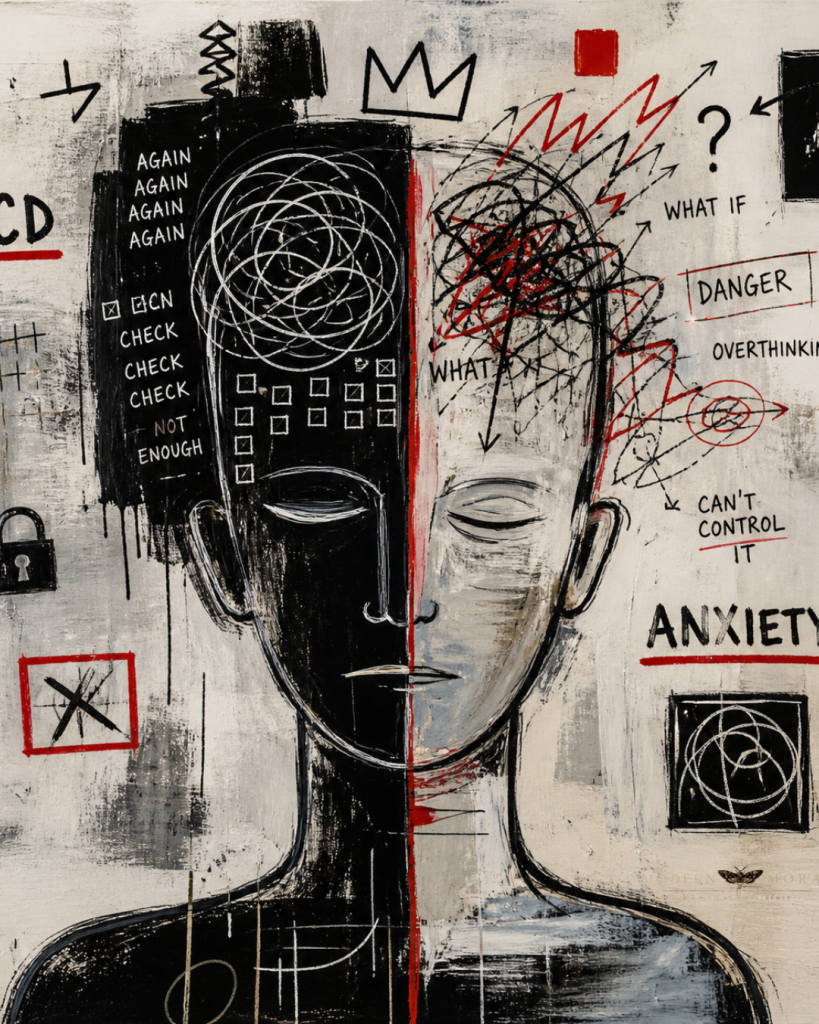
Many people wonder whether OCD is classified as an anxiety disorder. While the condition was once listed under anxiety disorders, it now has its own category in the DSM-5. However, anxiety remains a major part of OCD symptoms.
So then, is OCD an anxiety disorder? Obsessive-Compulsive Disorder (OCD) can be mentally and emotionally exhausting. It often involves intrusive thoughts, intense doubt, anxiety, and compulsive behaviors or mental rituals performed in an attempt to gain relief. It’s a complex disorder that comes in various sub-types including relationship OCD, harm OCD, symmetry OCD, religious or moral OCD, contamination fears, and more. The severity of OCD can vary from person to person, but many individuals experience ongoing struggle, shame, frustration, and emotional fatigue.
In this article, you’ll learn what OCD truly involves and whether it is classified as an anxiety disorder. OCD is often called “the doubting disorder” because it feeds on uncertainty and fear. While OCD now has its own diagnostic category, anxiety is still deeply connected to the experience. Understanding the role anxiety plays in OCD can help people better recognize symptoms, break compulsive cycles, and begin healing from intrusive thoughts.
Is OCD Still Considered an Anxiety Disorder?
According to the most recent edition of the Diagnostic and Statistical Manual of Mental Disorders (DSM-5), Obsessive-Compulsive Disorder is no longer officially classified as an anxiety disorder. There is significant comorbidity between OCD and anxiety disorders because both share biological and psychological vulnerabilities, making treatments such as cognitive behavioral therapy (CBT) and Exposure and Response Prevention (ERP) highly effective for both.
Both OCD and anxiety disorders share a fascinating genetic and neurological foundation and to break down the connection, you have to look at the wiring of the brain. Although, there are key differences which is why they are categorized separately, they often share the same biological roots.
There are clusters of genes related to neurotransmitter regulation (like serotonin and glutamate) that are common to both. Genetically speaking, if a first-degree relative has OCD, family members are at a higher risk not just for OCD, but for various anxiety disorders.
Other anxiety disorders are Generalized Anxiety Disorder (GAD), social anxiety, panic disorder, and specific phobias. Often, OCD is transmitted through a parent or it may be caused by stressful environmental factors experienced at a young age.
As mentioned, anxiety disorders and OCD share roots in the brain, particularly in the amygdala which is viewed as the panic button. Imagine this part of your brain as a smoke detector. In GAD, the detector is broken and emits a constant annoying beep which makes you keep checking the stove, even if there is no smoke. You begin to increase in worry that something bad is coming.
No, OCD is no longer classified as an anxiety disorder. It now has its own category in the DSM-5, although anxiety is still a major part of OCD symptoms.
In OCD, the detector is extremely sensitive. A single speck of lint hits it, and it triggers a chaotic noise. A thought may look like “I didn’t wash my hands enough, now I’m going to die from disease.”
Basically:
- Anxiety is the emotional state: fear, worry, tension, dread, nervous system activation.
- OCD is a disorder pattern where intrusive thoughts + doubt + anxiety lead to compulsions or mental rituals.
- Anxiety can be the feeling of worry
- OCD is the loop that keeps manufacturing worry and demanding resolution
The prefrontal cortex is unfortunately broken in the mind of those with the disorders. This part of the brain is the security guard who is supposed to let you know that the alarm is easily fixable and dust simply triggered it but the problem is this part of the brain seems to be asleep on duty.
Both consist of a lot of “what if’s” which causes a messy house. Someone with anxiety tends to be in constant worry of the future like what if their house burns down while someone with OCD has that worry but then spirals into present compulsions or rituals to attempt to relieve themselves of that stressful intrusive thought.
Why OCD Was Reclassified?
Unquestionably, anxiety is a core aspect in OCD but the fundamental to learn here is that in the standard OCD Cycle, the order is this: anxiety is a response to the obsession, not the starting point.
See it like this:
- Anxiety = triggered worry
- OCD = obsession or rumination = anxiety = compulsion = temporary relief = repeat
Unfortunately, the irrational thoughts or images push against your morals and make you question virtue and even what is universally believed as ethical. This is a trigger pattern and it brings no solid contentment and makes it difficult to see a complete thought through to a reasonable conclusion. I’m not stating that people with OCD are unreasonable, ethical, or highly sufficient and intelligent because we certainly are. But we tend to get caught up in a similar emotional pattern due to the triggers which are the current dread of a compulsion or rumination.
What is most interesting is that anxiety is not a trigger to OCD. Read that again. Anxiety is in the order of the OCD loop but it’s not necessarily what is the driver to start it. It’s a secondary effect as the relationship is more of an amplifier as anxiety can worsen OCD symptoms like the rumination (thought loop).
Other Emotions
Sometimes what is triggered by an obsession is not always anxiety.
Personally, as someone who severely struggled with religious and moral OCD, I often felt a deep, spine-rattling disgust or sometimes shame. Although the pattern was constant and intense, even it seemed to need periods of rest before returning again.
When I believed I was going to Hell because of a specific thought that latched onto my mind and drained my spiritual and emotional energy, I was given an antidote. The pastor of the church where I worked as a secretary told me that I had not blasphemed against the Holy Spirit because I was clearly an absolute wreck.
I loved God and felt tormented by the thought pounding against my mind. But he explained that my desire to understand the truth, to pray, remain faithful, and be as distressed as I was showed that those were not thoughts I wanted to keep or claim and that I belonged to nobody but Jesus.
The point is this: anxiety can be a range of negative emotions that keep the nervous system tense. Sometimes finding a remedy for the thought is helpful. Other times, healing begins by learning that you do not need to address every thought, solve every fear, or answer every mental accusation.
You can let it pass. You can come back to it later. And often, not returning to it at all is where freedom begins.
Highlights
- OCD can be mentally and emotionally exhausting, involving intrusive thoughts, intense doubt, anxiety, compulsive behaviors, and mental rituals used to seek relief.
- OCD is often called “the doubting disorder” because it feeds on uncertainty and fear.
- There is significant overlap (comorbidity) between OCD and anxiety disorders because they share biological and psychological vulnerabilities.
- OCD and anxiety disorders share genetic and neurological roots, including neurotransmitter systems involving serotonin and glutamate.
- The amygdala is described as the brain’s “panic button,” helping explain the fear response seen in both anxiety disorders and OCD.
- Anxiety is the emotional state: fear, worry, tension, dread, nervous system activation.
- OCD is the pattern where intrusive thoughts + doubt + anxiety lead to compulsions or mental rituals.
- Strong distinction: Anxiety can be the feeling of worry; OCD is the loop that keeps manufacturing worry and demanding resolution.
- OCD loop described clearly: obsession or rumination → anxiety → compulsion → temporary relief → repeat.
- Important clarification: People with OCD are not irrational, unethical, or unintelligent; they become trapped in a repeating emotional trigger pattern.
- Anxiety is in the OCD loop, but it is not always the main driver that starts the loop.
Leave a Comment!
Hi moral ones!
Thank you for taking the time to learn more about yourself or someone you care about or love. Please log in and leave a comment with any questions, thoughts, or if you want to email me directly, please visit the contact page.
What stuck out to you the most? Did you learn anything new?
Reminder, you are not your thoughts!
Source
How Anxiety and OCD are Related